- The Idea Farm
- Posts
- Energy Battles & AI Bubbles
Energy Battles & AI Bubbles
+ Stanley Druckenmiller, Michael Cembalest, Aswath Damodaran, Pension Funding & More

The Idea Farm
March 08, 2026
Sponsored by

“Pride of opinion has been responsible for the downfall of more men on Wall Street than any other factor.”
Research
Michael Cembalest’s 16th Annual Energy Paper looks at energy arguments, battles and debates: the impact of data centers on power prices, the true cost of small modular reactors, Germany’s decision to shut down nuclear, China’s dominance of renewable supply chains, the mostly profitless EV industry, and more.

This study uses the approach of Bessembinder to examine the real wealth creation of U.K. individual stocks between January 1975 and December 2024. It finds real wealth creation is highly concentrated and only 3.1% of stocks generate the aggregate net wealth created.

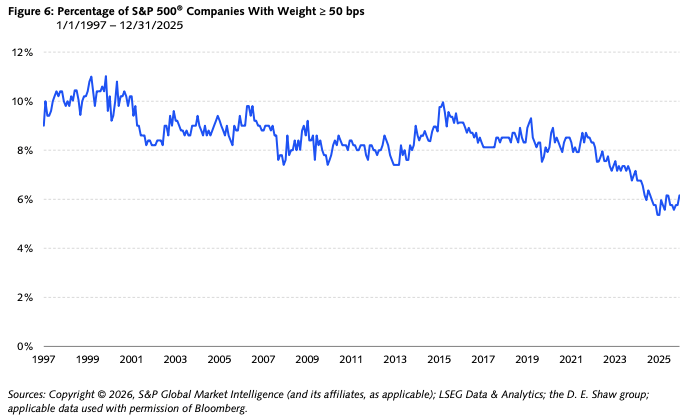
D.E. Shaw & Co. - The Concentration Game (11 pages)
D.E. Shaw considers the impact of increased concentration on benchmark-relative equity portfolios, both in terms of overall risk and the potential to generate alpha.

A Fed study suggest that Kalshi markets provide a high-frequency, continuously updated, distributionally rich benchmark that is valuable to both researchers and policymakers.

Paul Kedrosky and Man Group believe AI technology is transformative and here to stay, but the inflated financial architecture supporting it may be unsustainable. They highlight that AI-related exposure is increasingly metastasising through the economy, and this quiet migration of risk is the bubble’s distinctive feature.

Schroders - Anatomy of an “almost bubble” and why global equities now offer “something for everyone” (8 pages)
Schroders says global equities look more like an almost bubble than a classic blow off top, with AI optimism lifting valuations but not reaching the extreme euphoria seen in past manias. It suggests the best response is staying diversified and valuation aware rather than betting on a single bubble pop timeline.

Traditional valuation metrics for the U.S. stock market based on a comparison of the aggregate market value of U.S. corporations to measures of dividends, earnings, output, and the replacement cost of measured capital have been above historical norms for the past 25–30 years. This paper says we should not expect traditional stock market valuation metrics other than the free cash flow yield to return to their historical means.

Source: Federal Reserve Bank of Minneapolis. As of January 2026.
Bonus Content
AngelList analyzed more than 15,000 seasoned Seed investments, and one clear lesson stood out: writing smaller checks (presumably into investment rounds that forced GPs into smaller allocations) outperformed rounds where GPs could take their typical allocations. Read | Listen
Professor Damodaran analyzes how much cash to return to their owners, in what form (dividends or buybacks), and how that decision played out globally in 2025. Link
The Milliman Public Pension Funding Study annually shares the funded status of the 100 largest U.S. public pension plans. Link
Allianz’ 2026 edition of the Country Risk Atlas assesses the economic outlook, risks and opportunities across 83 countries, representing approximately 94% of global GDP. It found that global country risk improved in 2025. Link
The Contrary Research Tech Trends report features 350+ slides on everything from computational intelligence to lunar bases to breakthroughs in biologics & more. Link
Inflation. Deflation. Regime Shifts.
Is Your Portfolio Prepared for Both?
Markets don’t always move in one direction, and macro regimes rarely repeat. Investors may remember 2020, when the market experienced one of the fastest deflationary shocks ever recorded. Fast-forward two years to 2022, and advisors navigated a rapid inflationary cycle with unprecedented hiking of rates. Traditional 60/40 portfolios failed to diversify.
The challenge isn’t predicting what’s next. It’s preparing for whatever the market may throw your way.
Join us LIVE on March 26th to explore how trend following exposures like the Alpha Architect High Inflation & Deflation ETF (HIDE) may help build more robust, evidence-based portfolios.
Investing involves risk, including possible loss of principle. Investors should carefully consider the investment objectives, risk, charges, and expenses of the Fund. This and other important information is in the indicated Fund's prospectus, which may be obtained by calling (215) 882-9983 or by visiting https://funds.alphaarchitect.com/documents/. The prospectus should be read carefully before investing. Diversification and asset allocation strategies do not ensure a profit or protect against loss. Past performance is not a guarantee of future results. The Fund is distributed by PINE Distributors LLC.
Podcasts
 1/21/2026 - 39 minutes | Joe Gebbia touches on digitizing federal retirement, modernizing .gov sites, and applying design to public services. |
 2/27/2026 - 36 minutes | Druckenmiller shares how he would construct a portfolio if he had to start over today, why contrarianism is overrated, and which stock he regrets selling too early. |
 2/24/2026 - 75 minutes | Sundheim discusses investing across public and private markets, AI venture bets like OpenAI and Anthropic, and how he manages tail risk and concentration. |
What Else Is Happening
 3/6/2026 - 39 minutes | Kristin Olson discusses the boom in alternatives, what’s pulling more individual investors into private markets, and how AI is changing sourcing, underwriting, and portfolio construction. |
Did you miss last week’s email?